- Professional Branding: Route all outbound campaign emails through your affiliated domain instead of personal addresses.
- Build Sender Reputation: A gradual ramp-up and health monitoring reduce the chance of spam filtering.
- Campaign Automation: Powering multi-step email sequences with tracking and analytics.
- Centralized Control: Managing all outbound communication from one platform.
The separation between outbound mailboxes (for cold outreach) and your primary email accounts (for business communications) is a best practice that protects your organization’s email reputation while enabling scalable prospecting efforts.
Prerequisites
- Admin access to organizational settings.
- Appropriate subscription plan with mailbox allocation.
- Understanding of team email volume requirements.
Step-by-Step Instructions
1. Domain Setup
Learn more about purchasing domains in Purchasing & Managing Domains.- Navigate to Settings → Email setup → Domains tab.
- Click Add domain to purchase a new domain through Reevo. Each domain must be purchased with at least one mailbox.
- Wait for domain setup to finish (usually about one day).
- Check that the domain’s status shows Active before proceeding.
2. Understand Mailbox Types
Two types of mailboxes are available:- Managed: Mailboxes purchased through the platform with full health monitoring.
- Connected: Mailboxes that link existing external email accounts (like Gmail or Microsoft 365).
Managed (Recommended)
Connected
3. Set Up Your Mailbox
Create Managed Mailboxes (Recommended)
- In Settings → Email setup → Mailboxes tab, click Add mailbox.
- Choose Create a new mailbox.
-
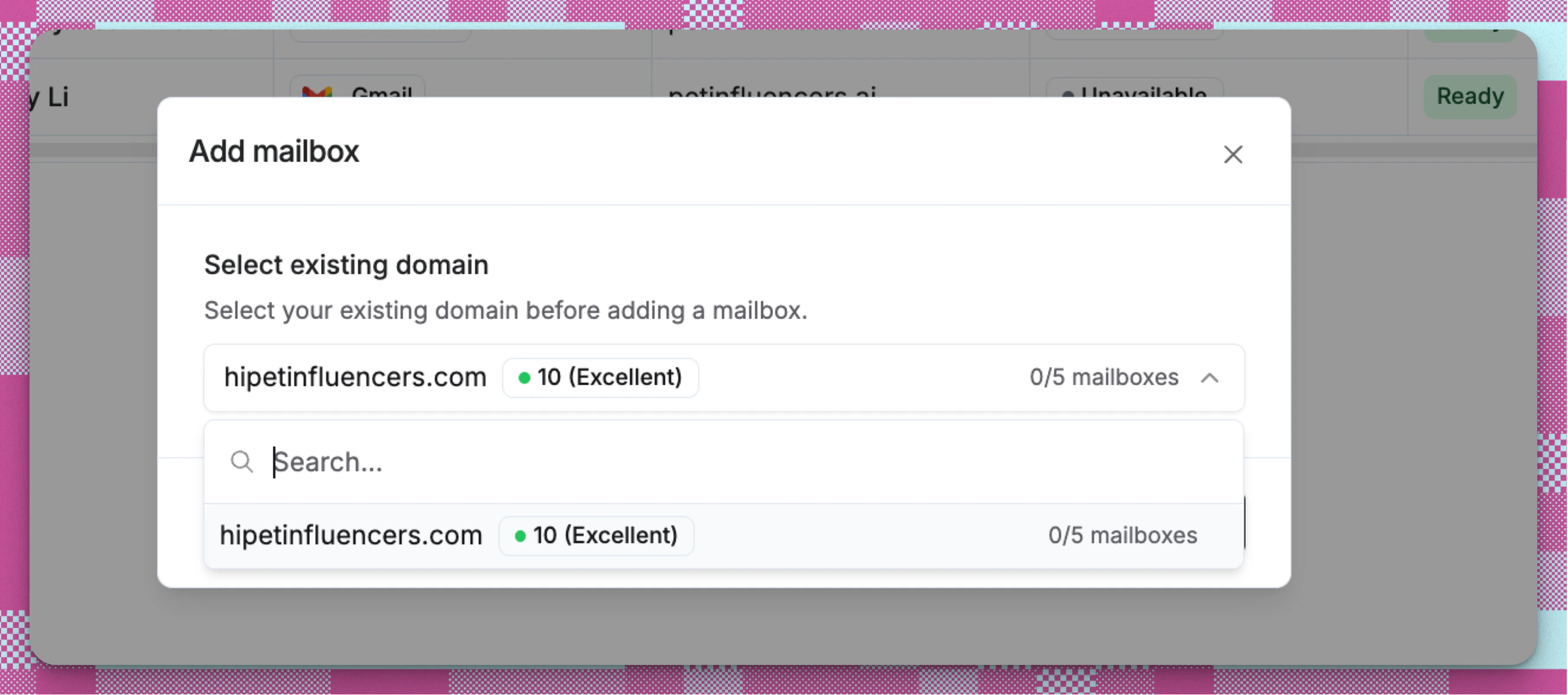
Under Select existing domain, choose the domain and click Next. Each domain supports up to 5 mailboxes. If the domain is full, add a new domain first.
-
Configure the Mailbox settings:
- Add mailbox: enter a name for each mailbox. You have complete freedom to name mailboxes in whatever way helps you stay organized. Outbound emails always show the owner’s name and the official domain - never the internal mailbox label.
- Owner: assign an owner from your team. The owner of the mailbox will show up as the sender in outbound emails.
- Ramp-up speed: choose Regular (+2 emails each business day, recommended) or Slow (+1 email each business day). Regular is only available on domains that are at least 30 days old. The speed can’t be changed after setup.
- Warm up first (optional, off by default): sends warm-up emails for 14 business days before the ramp starts. If you turn it on, set Warm-up emails per day between 1 and 10 (default 5).
- Emails sent per day: the daily limit the mailbox ramps up to. Reevo recommends 25. You can enter up to 2,000, and Reevo shows a deliverability warning rather than blocking you. Setting it to 0 disables the mailbox for sequences.
- (Optional) Signature: link an email signature.
- Click Next, review the Mailboxes purchase summary, and click Purchase.
- New mailboxes show Attempting to Purchase for about 30 minutes while Reevo sets them up. They are added to your default sequence pool automatically. Each mailbox starts ramping with its first sequence email, or after 14 business days of warm-up if you turned on Warm up first. To learn more, see Mailbox Ramp-Up.
Import Existing Mailboxes via SMTP/IMAP
Before Connecting a Mailbox on Your Existing Domain
When you connect an existing mailbox, your email provider continues to send the messages, and your organization remains responsible for the domain’s DNS configuration and sender reputation. Connecting the mailbox to Reevo does not create or repair SPF, DKIM, or DMARC records, and it does not reset an existing domain or mailbox reputation. Before connecting a mailbox on a custom domain:- Confirm who manages your DNS and email. Your domain registrar, DNS host, and email provider can be different companies. Make sure an administrator can update records at the authoritative DNS host and access your email provider’s authentication settings.
- Verify SPF. Keep one SPF record for the domain and confirm it authorizes every service that sends email for you. Do not replace an existing SPF record without accounting for your other sending services.
- Enable DKIM signing. Follow your provider’s setup instructions for Google Workspace or Microsoft 365.
- Configure DMARC reporting. DMARC depends on aligned SPF or DKIM. Start with a monitoring policy and an aggregate-reporting address, review legitimate sending sources, and move to enforcement only when you understand the impact.
- Check existing reputation. Review recent bounce and complaint activity, confirm the domain is not on a public blocklist, and investigate any previous sending or ownership issues before increasing volume.
Import a Single Mailbox
- Ensure you have admin credentials in the external email account (i.e. Google Workspace).
- In Settings → Email setup → Mailboxes tab, click Add mailbox.
- Choose Import existing mailboxes, then Single import.
- Complete the form. It walks you through the account details, the SMTP and IMAP connection settings, the sending configuration (including the Ramp-up speed, which depends on the mailbox’s domain age), and a payment review. If your plan’s included mailboxes are already used, the import adds a monthly mailbox charge, which the payment review shows before you confirm.
- Different providers may require an app-specific password (different from your account password) to connect your external mailbox. As an example: Here’s how to create one with Google. Check with your mailbox provider if the account password does not work.
- To use Reevo’s warm-up, turn on Warm up first in the sending configuration (some mailboxes show an Enable email warmup checkbox instead). Warm-up is off by default, so choose it while you import the mailbox.
Bulk Import Mailboxes from a CSV
Use bulk import to add up to 50 SMTP/IMAP mailboxes at once.- In Settings → Email setup → Mailboxes tab, click Add mailbox.
- Choose Import existing mailboxes, then Bulk import.
- In Bulk import settings, choose the owner, Daily quota, Delay between emails, and warm-up settings. These apply to every mailbox in the file.
- In Upload mailboxes, click Download CSV template and fill in one row per mailbox with these columns:
email,smtp_host,smtp_port,smtp_username,imap_host,imap_port,imap_username,app_password,first_name,last_name. Delete the example row before uploading. - Upload the completed CSV (CSV files only, max 50 records). Reevo checks each mailbox’s domain age and shows the Ramp-up speed each mailbox will use. Mailboxes on domains under 30 days old ramp at Slow.
- Click Import mailboxes. Reevo validates every mailbox’s credentials. Mailboxes your plan doesn’t cover add a monthly charge, and Reevo shows the total before you confirm.
- Open the Import runs tab to follow progress. When the run shows Awaiting confirmation, open it, review the results, and click Confirm import to create the mailboxes. You can also click Cancel import to stop the run without creating any mailboxes.
Import a Gmail Mailbox via Google Sign-In
Connect an existing Gmail or Google Workspace mailbox using your Google account. This method sends through the Gmail API directly - no manual credential entry, better deliverability, smarter retry handling, and replies that stay properly threaded in conversations.- In Settings → Email setup → Mailboxes tab, click Add mailbox.
- Choose Import Google mailbox.
- Read the Gmail usage guidance.
- Under Which email are you connecting?, enter the address. Its domain decides which Ramp-up speed options you can pick. Choose a speed.
- Click I understand, continue.
- Complete Google Sign-In in the popup window that opens, using the same account. If you sign in with a different account, that mailbox ramps at Slow.
- When prompted, grant the requested Gmail permissions.
- Once authorized, the popup closes and Reevo asks you to check how the mailbox sends. Review Outbound emails sent per day, Seconds between emails, and the signature, then click Save, or Skip for now to review later.
Import a Microsoft 365 Mailbox via Microsoft Sign-In
Connect an existing Outlook or Microsoft 365 mailbox using your Microsoft account.- In Settings → Email setup → Mailboxes tab, click Add mailbox.
- Choose Import Microsoft mailbox.
- Under Which email are you connecting?, enter the address and choose a Ramp-up speed.
- Click Continue with Microsoft and complete Microsoft sign-in in the popup window, using the same account.
- Grant the requested permissions. Once authorized, the popup closes and Reevo asks you to review the mailbox’s sending settings.
4. Mailbox Management
All created mailboxes appear in Settings → Email setup → Mailboxes. You can track the following fields:- Type: Reevo-managed mailboxes show an Outbound badge. Mailboxes you connect show a Connected badge, and mailboxes you import show an Imported badge.
- Domain: the mailbox’s associated domain.
- Status: Attempting to Purchase, Purchase failed, Warming up, Ramping, Ramped, Not in use, or Archived. A mailbox that needs action also shows Requires re-authentication (sign in to the account again), Connection issue (for SMTP/IMAP mailboxes, use Reconnect to re-enter the credentials), or Needs setup (an imported mailbox whose sending settings you have not reviewed yet).
- Health: see Mailbox Health.
- Sequences: the sequences using the mailbox.
Troubleshooting / FAQs
Why are domains needed before creating mailboxes?
Why are domains needed before creating mailboxes?
Can existing Gmail accounts be connected instead of purchasing new mailboxes?
Can existing Gmail accounts be connected instead of purchasing new mailboxes?
Can I add Outlook or Microsoft 365 as an outbound mailbox?
Can I add Outlook or Microsoft 365 as an outbound mailbox?
My Microsoft 365 sign-in says an admin must approve Reevo. What do I do?
My Microsoft 365 sign-in says an admin must approve Reevo. What do I do?
Can mailbox settings be edited after creation?
Can mailbox settings be edited after creation?
What daily sending limit does Reevo recommend?
What daily sending limit does Reevo recommend?
Why can't I see all mailboxes in settings?
Why can't I see all mailboxes in settings?
What happens when I reach my mailbox limit?
What happens when I reach my mailbox limit?
What's the difference between connected and Reevo-managed mailboxes?
What's the difference between connected and Reevo-managed mailboxes?
Can I use both types of mailboxes?
Can I use both types of mailboxes?
Why would I choose Reevo-managed mailboxes?
Why would I choose Reevo-managed mailboxes?
Can I change mailbox types after setup?
Can I change mailbox types after setup?
How do deliverability features work with Reevo mailboxes?
How do deliverability features work with Reevo mailboxes?
What's the difference between domain health and mailbox health?
What's the difference between domain health and mailbox health?
How do mailboxes relate to email deliverability?
How do mailboxes relate to email deliverability?
Can I track individual mailbox performance?
Can I track individual mailbox performance?
Do mailboxes automatically renew?
Do mailboxes automatically renew?
What happens to active sequences if I archive a mailbox?
What happens to active sequences if I archive a mailbox?
Should I use my Gmail account for sequences?
Should I use my Gmail account for sequences?
What does Attempting to Purchase status mean?
What does Attempting to Purchase status mean?
Can I add more than one mailbox at a time?
Can I add more than one mailbox at a time?
How does mailbox rotation work?
How does mailbox rotation work?
What does the Needs setup badge mean?
What does the Needs setup badge mean?
What should I do if the Google Sign-In popup does not open?
What should I do if the Google Sign-In popup does not open?
Why did I see a Required Gmail permissions were not granted error?
Why did I see a Required Gmail permissions were not granted error?
gmail.modify permission to send and sync email on your behalf. If you declined any permissions on the Google consent screen, the connection cannot complete. Click Import Google mailbox again and accept all permissions when prompted.What does This email is already connected to your organization mean?
What does This email is already connected to your organization mean?
How do I reconnect a mailbox if the connection expires or is revoked?
How do I reconnect a mailbox if the connection expires or is revoked?
What is the difference between Google Sign-In import and SMTP/IMAP import?
What is the difference between Google Sign-In import and SMTP/IMAP import?
Why does my Gmail mailbox start with a low daily limit?
Why does my Gmail mailbox start with a low daily limit?